

For many nonprofits, the middle of the year arrives before there has been time to catch up from year-end reporting, grant deadlines, board meetings, and day-to-day program work.
That can leave you with a familiar problem: your organization is active, funds are coming in and going out, but you are not fully confident that the books, records, and tax requirements are where they need to be.
A mid-year review gives you a chance to correct issues while there is still time to act. It helps you identify missing documentation, check whether restricted funds are being tracked correctly, prepare for upcoming filings, and give your board a more reliable view of the organization’s position.
This bookkeeping and taxes checklist is designed to help you review the areas that often create pressure later in the year. You do not need to solve every issue in one day. The goal is to know what needs attention now, before small gaps become larger problems.
Why Mid-Year Bookkeeping and Taxes Reviews Matter for Nonprofits
Nonprofits often manage more financial complexity than people expect. You may receive grants with reporting requirements, donations restricted to specific programs, earned income, payroll obligations, vendor payments, and reimbursements. Each item needs to be recorded clearly enough for leadership, funders, and regulators to understand.
When bookkeeping falls behind, the impact reaches beyond the general ledger. You may struggle to explain program spending to your board, prepare grant reports, track restricted funds, plan for payroll, or complete year-end tax filings without a rush.
A mid-year review does not replace monthly bookkeeping. It gives you a structured opportunity to check whether your regular process is producing accurate, useful information.
For organizations that need help maintaining current books and financial reports, Accounting Services can support core accounting responsibilities throughout the year.
Start With Your Bank and Credit Card Reconciliations
Your first priority should be confirming that every bank account and credit card account has been reconciled through the most recent completed month.
A reconciliation compares the transactions in your accounting system with your actual bank or card statement. This helps identify transactions that may be missing, duplicated, incorrectly categorized, or still uncleared.
Pay close attention to older unreconciled items. A check that has remained outstanding for several months may have been lost, voided, or entered incorrectly. An unexplained bank deposit may be a donation, grant payment, program fee, or duplicate entry that has not been identified.
You should also review whether personal expenses have been reimbursed correctly and whether every organizational credit card has been reconciled, rather than simply paid off.
Your reports are only as reliable as the accounts behind them. If reconciliations are incomplete, start there before relying on your income statement, balance sheet, or cash balance to make decisions.
Review Donations, Grants, and Restricted Funds
Nonprofit bookkeeping needs to show more than total income. You also need to know where funds came from, what restrictions apply, and whether the money has been used according to donor or grantor requirements.
At mid-year, review whether donations and grant payments are being recorded to the correct funding source. Restricted donations should be clearly separated from unrestricted revenue, and grant income should be linked to the relevant program, project, or reporting period.
Grant award letters often include specific conditions. Funds may be limited to certain programs, locations, expense categories, or periods. Your books should make it possible to prepare a grant report without having to manually reconstruct months of activity.
It is also important to consider whether grant revenue is being recorded in the right period. Receiving cash does not always mean all related revenue should be recognized immediately. Some grants include conditions that affect how and when revenue is recorded.
Clear records help your organization show funders how resources were used and reduce the risk of restricted funds being used for unrelated purposes.
Compare Actual Results to Your Budget
Your budget should be a working tool, not a document that is only reviewed at the beginning and end of the year.
At the halfway point, compare actual income and expenses with what you expected. You do not need to focus on every small difference. Instead, look for the changes that could affect your plans for the rest of the year.
For example, donation income may be coming in slower than expected. Payroll may be higher because of new hires, overtime, or contractor work. Program costs may have risen because participation is higher than planned. A major grant may have been delayed, reduced, or restricted differently than expected.
The purpose is not to label every variance as good or bad. It is to understand why it happened and whether it changes what your organization should do next.
Lower-than-expected income may mean delaying a purchase, reviewing fundraising activity, or adjusting planned spending. Higher program costs may be reasonable if demand has grown, but your leadership team still needs to understand whether those costs can be sustained.
This type of review connects closely with Financial Planning, where budgeting and forecasting help you plan for different financial outcomes before cash becomes tight.
Check Receivables and Grant Reimbursements
Not every nonprofit receives income upfront. You may be waiting on grant reimbursements, pledged donations, sponsorships, program fees, contracts, or invoices.
Review your accounts receivable report and identify amounts that are older than 30, 60, or 90 days. Ask whether follow-up is needed, whether grant reimbursement requests have been submitted, and whether outstanding balances are still likely to be collected.
A strong income statement can create a false sense of security when too much income remains unpaid. Your nonprofit may show a surplus on paper but still struggle to cover payroll or vendor obligations if expected cash has not arrived.
Create a clear follow-up process for overdue balances. Assign responsibility for contacting funders, customers, or sponsors, document the communication, and set a point where the organization decides whether an amount should remain collectible.
Review Payroll, Contractors, and Payroll Tax Records
Payroll errors can affect employees, tax filings, benefits, and year-end reporting. Mid-year is a useful time to confirm that payroll information is complete and that payments are being recorded correctly.
Review employee details, tax withholding forms, pay rates, approved compensation changes, and paid time off records. You should also compare payroll reports from your provider with payroll expenses in your accounting system. Differences may indicate that payroll entries, benefit costs, or tax payments have not been recorded correctly.
If your nonprofit pays independent contractors, make sure current W-9 forms are on file. Waiting until January to request missing tax information can delay year-end reporting and create unnecessary pressure.
You should also consider whether contractor classifications remain appropriate. The distinction between employee and contractor status has tax and compliance implications, especially when a contractor works consistently under the organization’s direction.
The IRS provides nonprofit tax resources and guidance that can help you understand filing requirements and employer responsibilities.
Confirm Sales Tax and Other State Tax Responsibilities
Federal tax-exempt status does not automatically remove every state and local tax requirement.
Depending on your activities and location, your nonprofit may need to consider sales tax on merchandise, event tickets, food sales, or fee-based services. You may also have state charitable registration obligations, unemployment tax responsibilities, local business license requirements, or tax considerations related to unrelated business activity.
Review whether your organization has introduced a new revenue-generating activity during the year. An online store, ticketed event, rental arrangement, sponsorship package, or fee-based program could create tax responsibilities that were not previously relevant.
For example, selling merchandise may be treated differently from collecting donations. Income from an activity that is not substantially related to your exempt purpose may also need separate consideration.
This is one area where Tax services can be useful when you need help understanding deadlines, filing obligations, and the effect of new activities on your organization.
Review Expense Documentation and Approval Processes
Accurate expense records help protect your organization and make reporting easier. At mid-year, check whether your team is consistently keeping receipts, invoices, approvals, and support for reimbursements.
Look for vendor payments without invoices, reimbursements without supporting documentation, vague expense categories, duplicate charges, and purchases coded to the wrong program or grant.
This review can also reveal subscriptions and recurring expenses that are no longer necessary. A monthly software charge or service contract can continue for months simply because no one has reviewed it.
Good documentation matters for grant reports, financial statement reviews, audits, and board accountability. It also gives you more reliable information when comparing actual spending to your budget.
Assess Your Financial Controls
Internal controls are the processes that help reduce errors, protect assets, and ensure that financial activity receives appropriate oversight.
You do not need a large finance department to have effective controls. Even smaller nonprofits can put practical checks in place, such as requiring two people to review larger payments, separating approval and reconciliation responsibilities where possible, and making sure the board receives regular financial information.
Your controls should cover areas such as bank account access, check signing authority, online payment approvals, credit card use, vendor changes, donation handling, cash received at events, expense reimbursements, and monthly reporting.
If one person is responsible for receiving funds, approving payments, entering transactions, reconciling accounts, and creating financial reports, the organization may be exposed to unnecessary risk. Independent review can help identify honest mistakes as well as suspicious activity.
Organizations preparing for a financial statement review, audit, or funder-required engagement may also benefit from understanding Audit and assurance requirements before records are requested.
Review Upcoming Filing and Reporting Deadlines
Create a calendar of every filing, report, and renewal due during the rest of the year.
Your requirements will depend on your organization’s structure, location, funding sources, and activities. They may include payroll tax filings, annual information returns, charitable registration renewals, sales tax returns, grant reports, insurance renewals, business license renewals, and board reporting dates.
Do not rely on one person’s inbox or memory. Place deadlines in a shared calendar and make sure each responsibility has a clear owner.
You should also confirm that the organization’s legal name, Employer Identification Number, address, officer details, and registered agent information are current. Outdated records can create issues when filing forms, receiving notices, or completing grant applications.
Use Financial Ratios to Identify Changes Early
Financial statements show amounts. Ratios help you understand how those amounts relate to each other.
For nonprofits, useful measures may include months of cash on hand, the current ratio, program expense ratio, fundraising efficiency, revenue concentration, and operating reserve ratio.
A low number of months of cash on hand may show that your organization has limited room for delayed grant payments or unexpected expenses. Heavy reliance on one funding source may also create risk if that relationship changes.
You can calculate several useful measures with a Finance ratio Calculator. The real value comes from comparing results over time and discussing what the trends mean for your organization’s plans.
Your Mid-Year Bookkeeping Checklist
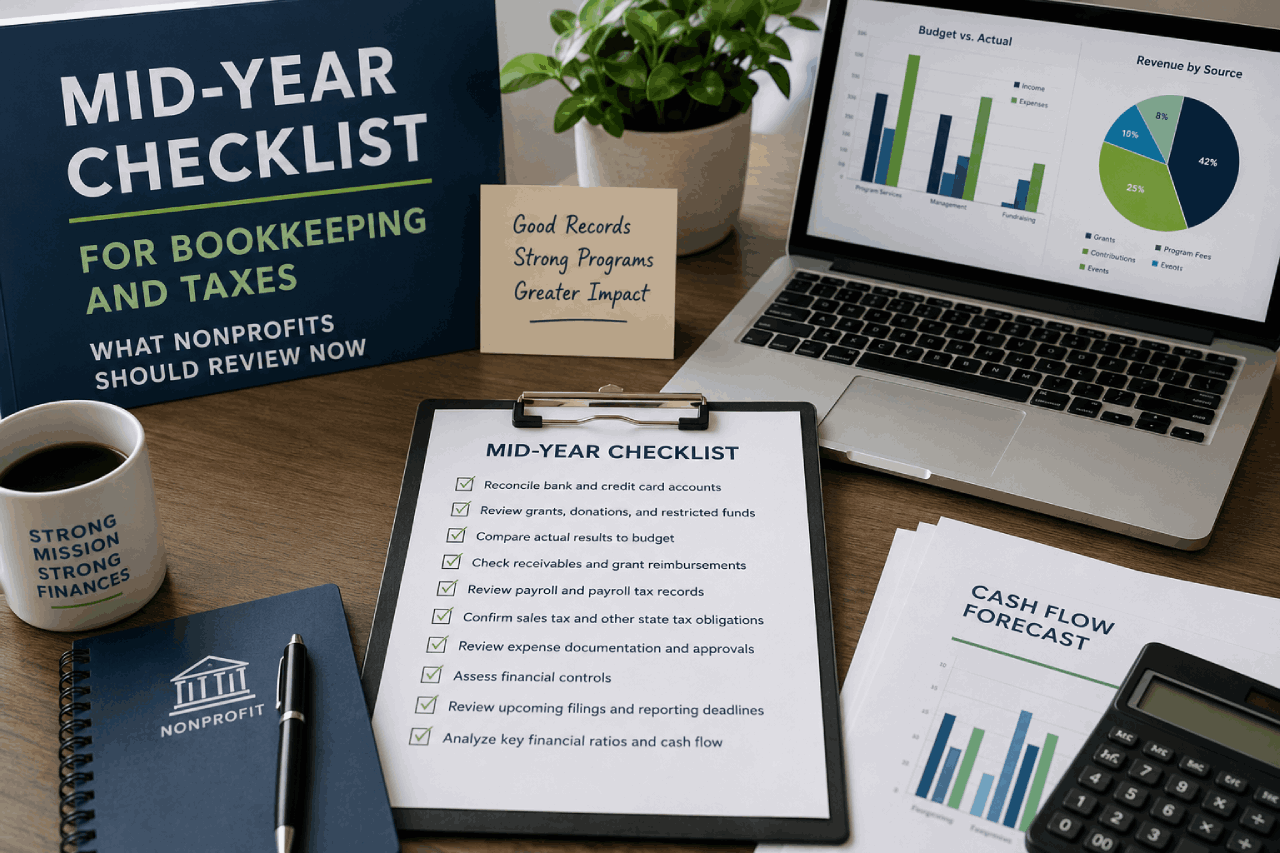
Use this bookkeeping checklist to make sure your review is complete:
- Reconcile every bank and credit card account.
- Review grants, donations, and restricted funds.
- Compare actual results with the annual budget.
- Follow up on overdue receivables and grant reimbursements.
- Confirm payroll, contractor, and payroll tax records.
- Review upcoming tax filings, grant reports, and renewal deadlines.
When You Need More Support
A mid-year review may show that your organization needs cleanup work, better reporting, or more consistent financial processes. That does not mean your team has failed. It means you have identified areas that need attention before year-end.
Some nonprofits need monthly bookkeeping support. Others need help with tax filings, grant tracking, financial reporting, or audit preparation. Reviewing Pricing can help you understand the type of support that may fit your organization’s needs.
For questions about your nonprofit’s records, reporting process, or upcoming requirements, you can Book a call orChat to us.
FAQs
Why is bookkeeping important for nonprofit taxes?
Accurate bookkeeping provides the records needed to prepare tax filings, support exemption-related reporting, document payroll activity, and respond to questions from regulators or funders. It also helps ensure that restricted funds and program expenses are recorded correctly.
What should nonprofits review at mid-year?
Your nonprofit should review bank reconciliations, restricted funds, grant income, expenses, payroll, receivables, budget performance, filing deadlines, and financial controls.
How often should nonprofit bookkeeping be updated?
Most nonprofits should update bookkeeping at least monthly. Organizations with higher transaction volumes, multiple grants, payroll, or active programs may need weekly bookkeeping tasks to keep records current.
Are bookkeeping and tax services the same thing?
No. Bookkeeping focuses on recording and organizing financial activity. Tax and bookkeeping services may be provided together, but tax work generally includes filing returns, reviewing compliance obligations, and planning for tax-related requirements.
What accounting software should a nonprofit use?
The right software depends on your size, funding structure, reporting needs, and staff capacity. Many nonprofits use tools such as QuickBooks, but the most important factor is having a consistent process for entering transactions, reconciling accounts, and producing reports that leadership can use.